




Archive for June, 2010
Bark for Life ...
By Nancy Hassel, LIPetPlace.com
Bark for Life” that took place in Riverhead, NY, on Saturday evening June 12 was a howling success! More than one hundred participants and their dogs took part in the event, which was the first of its kind on Long Island. The event was based on the American Cancer Society’s ‘Relay for Life’ events that take place across the country. With many survivors in attendance, both human and dogs, they are living proof that beating, surviving and living beyond the diagnosis of cancer is more than possible.
Many of the dogs, (and their owners), took place in the relay and the many doggie games and competitions throughout the evening. Participants including the four-legged and two-legged kind were all having a great time, and a lot of tail wagging was happening across the park. Raffles to benefit the American Cancer Society and lots of giveaways by vendors – gave attendees armfuls of great treats and toys for their dogs. We know the dogs will be barking for this event to become an annual dog walk!
Check out the slide show here:
http://www.slide.com/r/NGFHth556T-TBz_W3ay2fQ9WloK_mD42?previous_view=mscd_embedded_url&view=original


June 7, 2010
by Nancy E. Hassel, LIPetPlace.com
Wine country on horseback
A unique and fabulous way to see the countryside of the North Fork and enjoy the fruits of the vine while on horse back, the 7th Annual Vineyard Ride took place on Saturday, June 5th. Events like this often taking place in California, has now become a tradition on the North Fork every June, but it attracts riders from all across Long Island. This event was sponsored by local Long Island horse groups the Nassau Suffolk Horseman’s Association, Inc., Old Field Farm, Ltd. and East End Livestock and Horsemen’s Association.
A beautiful albeit warm day, this year there were 83-seasoned horse back enthusiasts riding approximately 10-miles round trip starting from Martha Clara Vineyards. Taking the back roads along vineyards and through beautiful farmland, the first stop on the tour was Paumanok Vineyards.


Divided into different groups, the first group “Cabernet Sauvignons” aka the fast group, (trotting and possibly cantering), arrived at Jamesport Vineyards and were greeted by lots of water for the horses, bottled water for people and of course a tasting of wines offered by Paumanok Vineyards. The amazing thing to see was the wide variety of different horse back riding disciplines. There were English riders, Western riders, decked out in Cowboy hats of course, jumpers and horses also varied just as much – from thoroughbreds, Friesians, quarter horses, painted, and many more.
What a sight to see a group of riders and their horses rounding the bend of grape vine rows, not an everyday sight even for the NoFo folks. Almost all the riders hosed down their horses, gave them water, and dismounted at each vineyard.


Each group had numerous guides, volunteers and a lot of smiling faces. The very few and very short places that the riders were roadside, a police car escort was there to assist.

In speaking with many of the riders, this was their 2nd or 3rd time attending and they said it is absolutely one of the best rides they do all year. There were many volunteers at each stop to assist the riders, help with the horses and all were also horse owners and very horse savvy. The majority of the riders were there with their own horses.
Riders ranged from ages in their mid-20’s to late 70’s. The 3rd stop was back at Martha Clara where riders also enjoyed a delicious lunch. The cost for the tour was $95 per person donation including lunch and all proceeds from this fundraiser go towards benefiting the restoration of Old Field Farm, an historic equestrian parkland, and the ongoing mission of Nassau Suffolk Horseman’s Association as it strives to preserve L.I. as horse country. A magnificent day and beautiful country side, and amazing way to tour the vineyards, I am definitely going to take part next year – but this time on a horse! Reservations for participating fill up fast, and they will stay under 100 horses to ensure safety for each rider and group of riders. What a fantastic tradition, now if we can just get them to do it in the fall too, hmm.
Click here to see a slideshow of the event:
http://www.slide.com/r/Tq6M3jYA6j8RUHZoj8whxbdMa093N1OS?previous_view=mscd_embedded_url&view=original

July 7, 2010
By Pamela Fitzpatrick, of YourDogWalkers, shihtzu58@optonline.net
HEAT WAVE – HOT WEATHER TIPS
For pet owners, a heat wave like the one we’re currently experiencing requires taking extra care to ensure pet safety. NEVER leave any animal inside a parked car during the summer- a car can heat up to 120 degrees in just a matter of minutes even on a much cooler day than today. Leaving car windows open wont help! Pets can quickly suffer heatstroke, brain damage, and death if left trapped in high temperatures.
Make sure your dog or cat has plenty of fresh, clean water at all times. Consider floating ice cubes in water bowls to help keep the water cool. Keep animals inside, in air conditioning if possible. If you don’t have air conditioning, try placing a large bowl of ice in front of a fan to circulate cooler air.
Dogs are particularly susceptible to heat related problems, in part because they can only cool themselves by panting and sweating through their paw pads. Short nosed breeds, (Boxers, Pugs, Pekinese, Shih Tzu’s etc) and well as longhaired, overweight, and very young or old animals are especially at risk
Signs of heat stress in dogs include:
- Heavy Panting
- Glazed Eyes
- Rapid Pulse
- Unsteadiness
- Vomiting
- Deep red or purple tongue
If your pet does become overheated, you must act quickly to lower their body temperature!
Move the animal into the shade and immediately apply cool (not cold) water over their body to gradually lower the temperature The dog should be taken to the veterinarian’s office or to an emergency veterinary clinic immediately. Most dogs will not drink water at this stage of heat stroke, so don’t waste time trying to get them to drink. Get to the vet’s as quickly as possible.
Remember, if it’s too hot for you, it’s too hot for your pet!

June 6, 2010
by Nancy E. Hassel, LIPetPlace.com
Did you know that not all dogs can swim? Most people think that swimming comes naturally to dogs. We have all seen the funny videos of little dogs doing the doggie paddle in the air when held above the bath water by their owners, but that movement doesn’t mean they will be able to swim, stay afloat or tread water.
Being on an Island, dog owners should consider this when out at the beach, near a lake with their dogs, or hanging out by the pool. We are lucky that nowadays there are life jackets made for dogs, scamper ramps to help dogs out of a pool and dog trainers willing to teach dogs to swim. But that doesn’t mean your dog is going to like it or have a swimming technique come naturally to them.
Some things dog owners should never do when trying to get your dog to swim, is force your dog into the water by dragging or throwing a dog in. It’s not only cruel, but can scare a dog or make the dog fearful of water. If you have a puppy, you want to start young introducing the pup to the water, always, always monitored by an adult and never left alone near a body of water. Keep the puppy leashed, and it you have a dog life jacket (properly fitted for the dog’s size), have the puppy wear it. You can get the puppy accustomed to wearing it, by having the dog wear the vest for a few minutes at a time while indoors or on a short walk. While the puppy is leashed you can go into a pool or in the calm water on a shore and just have the pup wade in the water along side of you. Let the dog go in on its own or if you have a dog or friend with a dog that likes the water – that will often help your puppy have less fear.
When teaching the puppy how to swim, make sure that you eventually take the life vest off during lessons for short periods of time, so the dog learns to become buoyant on their own. Owners can assist by helping hold up the dog’s body from the mid to back section of the dog:
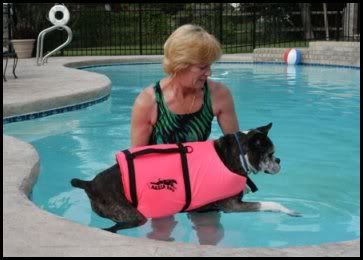
Photo, American Boxer Club.
Some dog breeds do take much more naturally to the water as that is what they were bred for. Labs, Goldens, Portuguese Water Dogs, Chesapeake Bay Retrievers, to name a few are natural water dogs, but they still may need help along the way learning. Some breeds are not designed for long swims or swimming at all. My Pit Bull Max, is an excellent swimmer, but his mouth is so wide that he tends to inadvertently swallow a lot of water while swimming. Which can make him sick, so his swim time is never more than 10 to 15-minutes, and that is in and out of the water.
If you are unsure how to teach your dog to swim, the best thing to do is to hire a skilled dog trainer who knows how to do this properly. (Interview the trainer to be sure they know how to teach this). In teaching a dog to swim it’s best to be in the water with the dog as some dogs can panic, and you or the dog trainer can help assist them out.
Another thing to consider is if you are at the ocean beach, be careful of throwing a ball or stick into rough surf – this could easily knock down a dog and injure the dog. Dogs can easily be tossed around by a wave. Some bay beaches have a quick drop off, and if your dog is not used to swimming, a deep drop off can be dangerous. While we all want our dogs to cool off, not every dog is suited to swim. So take steps to enjoy the water with your dog, but safety first!
Writer note: The life jacket can also be a safety precaution while out kayaking or boating with your dog. Also a long line, not a retractable leash, a long leash made of cotton that can be purchased at most pet stores in 10, 15, 25 and 50 in length, is a great tool while teaching a dog to swim. If the dog is over enthusiastic and not on a leash the dog can keep going and going. Believe me I have witnessed this in person. Funny at first, scary when the dog was pretty far out into the bay, luckily for the owner the dog turned and finally headed back. If the owner had a long line, he could have gently pulled the dog back towards the shore.
I owned a Doberman who was not a graceful swimmer at all, and her rear end always tended to sink, so her doggie paddle was more in the air than in the water. She also jumped off the dock once, and we had to coax her around the shore. She did it, but was panicked and exhausted when she came out. While she loved the water, she was smart enough to know her lack of swimming capability and only went out so far (where she could still stand!), not all dogs are that smart!
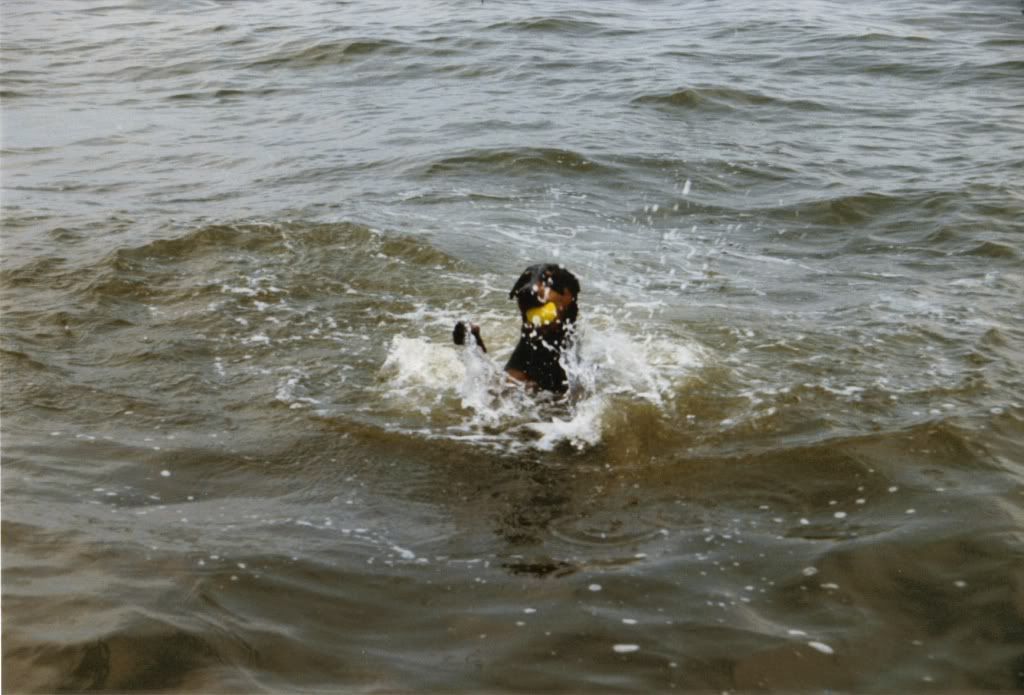
Don’t let this picture fool you, her back paws were touching here!
And this was clost to the shore of the bay.
June 2, 2010
By Nancy E. Hassel, LIPetPlace.com
June is Adopt-a-Cat Month
Did you know that June is “Adopt-a-Cat” month? It is appropriate, June being the time of year where kitten population seems to explode around our area. Most rescue organizations are inundated with unwanted mother cats and kittens, or feral kittens that were tame enough to be captured. Fortunately we have some wonderful organizations that take in many of these cats and kittens, but unfortunately they can’t take them all. Due to lack of space, funds to feed and care for them and specifically not enough people adopting them. A few of these organizations have actual “catteries” which are bigger than some people’s apartments, but the hope is not that they will live at the cattery forever – it’s that they will find a forever home. So if you have been thinking about getting a purring, snuggly cat or kitten, why not head down to your local shelter and see what is waiting there. While a kitten is irresistible, ask the shelter workers about a full grown cat that may have been there for a while, stuck in a cage, without the hope of adoption. An older cat may have outgrown the mischievousness antics of a kitten and make a nice transition into your home.
Some local places to look for you new furry friend are:
- Animal Rescue Fund of the Hamptons (ARF) – www.arfhamptons.org
- All About Spay & Neuter – www.allaboutspayneuter.com
- Forgotten Friends of Long Island – www.forgottenfriendsoflongisland.org
- Freeport Animal Shelter – www.freeportanimalshelter.com
- Last Hope Animal Rescue – www.lasthopeanimalrescue.org
- Grateful Paw Cat Shelter – www.laphuntington.org
- Little Shelter – www.littleshelter.com
- Kent Animal Shelter – www.kentanimalshelter.com
- S.A.V.E.S., Inc. – www.northfork.com/saves
- Southampton Animal Shelter – www.southamptonanimalshelter.com
*Writers note: Every cat I ever had was a stray or feral kitten – that lived long healthy lives well into their late teens. Some of them being smartest cats I have ever met, to the funniest characters – the cats that adopted us were a joy to own, easy to take care of and a big part of our family.

Categories
Archives
Blogroll
Meta