



Author Archive
Animals and Apps ...
by Pamela Fitzpatrick, of YourDogWalkers, shihtzu58@optonline.net
I recently joined the ranks of the more than 15 million ipad users and stepped into the world of tablet computing. I am amazed at what the Ipad can do! Entertainment, productivity, organization; it is incredible how useful a tool this is. I am writing this article on my Ipad to test out the word processing functionality. (So far, so good).
Out of curiosity i searched the Apple Itunes store for apps related to “pets” and came up with 128 results. The majority are games or educational (lots of kids games and cute wallpapers), but there are some interesting and potentially useful ones that petowners might be interested in. I have downloaded some and just read the descriptions of others, so this isn’t a review, just a sampling of what’s out there.
Free apps are the best…Life for Ipad, Humane TV and Daily LOL pets are a few of the free ones I found. Your preschooler can dress up cartoon cats with Dress Your Cat HD, or feed play and accessorize a puppy (Pet Puppy). Your whole family can enjoy great animal photos on LIFE for Ipad or take the breed quiz on the I know Dogs Breed Guide and quiz game. Looking for a dog park in NYC? There’s an app for that. (Long Island would be better, for any app developers out there).
Pet related apps run the gamut; cute, fun, useful, or strange.
Want the security of a barking dog to protect your home? The Barking Dog Home Security App can do that.
For the more organized pet owners among us, there are several options to track your pets medical history and vaccination records. Check out Dog Medical Agenda for Ipad, I pet Care, or My Dog. Horse owners may like Horse Medical Agenda for Ipad.
Om Nom? Can my dog eat it? (or OMG my dog ate it!) looks like a really useful guide either before or after the fact. i just downloaded it, and at first glance the information looks factual and comprehensive. Cant be used as a substitute for vet advice, but a handy guide to have.
If you have an Ipad and pet(s) check out the pet and animal apps. If anyone has any favorites apps, please let me know.
shihtzu58@optonline.net

By Nancy E. Hassel, LIPetPlace.com
Living on Long Island we are very fortunate that once a year the most prestigious and biggest dog show comes to New York City. The Westminster Dog Show draws thousands of dog lovers from around the world and is practically in our back yard. With approximately 90 dogs entered from Long Island owners – some of which are breeders, owners, handlers – this year was a first time showing at Westminster for many of those dogs. On Tuesday, February 15, 2011 a lot of the big dogs, and I mean this in size – not their status, took part in the competition. One of those beautiful big dogs was the very handsome, playful and young Bull Mastiff “Brutus” (Bandog’s Brutus the II of Raven). Owned by Mike and Marilyn Schamroth of Hewlett – they were more than excited to see their boy in the ring – his first time at Westminster. Mike & Marilyn have owned Bull Mastiffs before and have shown them – but it has been about 15-years since they have had the breed. When I asked them, what made you get a back into the breed Marilyn Schamroth said, “We were in Florida and we happened to go to a dog show and saw the most beautiful brindle puppy and that pup let us to the breeder who we got Brutus from – it was kismet.” Brutus who is now only 18-months old is already a champion and seasoned pro – he won the ‘Best of Winners’ at the Bull Mastiff Association Nationals in Massachusetts in Septembers 2010. Brutus was led to that championship by his handler, Rolissa Nash – a long time Bull Mastiff breeder, owner, and professional handler, accomplished dog trainer and co-owner of Doggie U K9 Academy in Bay Shore, NY. Mr. Schamroth said, “I can’t sing Rolissa’s praises enough – because with her it’s all about the dog, and the dog comes first – she has been fantastic to work with.”

Rolissa and Brutus in benching area.
Rolissa Nash said, “Brutus is a fantastic, even tempered, wonderful dog, eager to learn – a pleasure working with him and his owners. They are more concerned about their dog being content and happy and if they thought their dog was unhappy doing dog a show, they would pull him out of the show without even thinking about it. They want Brutus to be a well rounded dog so we have started him also in obedience and agility.”
Another new comer and Long Islander to show this year was “George” (CH BlacNFlat Burns and Allen) a Flat Coated Retriever owned by David and Carole Kralstein of Canine Club Getaway. George started his show dog career at a single cluster of shows in tough North east competition in July of 2010 and in just 5 days earned his Championship title. He also won ‘Best of Breed’ and G2 (2nd Place of the sporting group), at the October 2010 Westbury Kennel Club show on Long Island. He also won 3 more Best of Breed titles at the Talbot Kennel Club, the Salisbury Maryland Kennel Club in November 2010, and Worchester Kennel Club in Massachussetts in December 2010.
George a very sweet and handsome boy is a willing and happy worker, while remaining the typical Flat-Coat goofball. He is currently dabbling in agility, and will begin working on field training in the spring. George is also an accomplished Therapy Dog and has his Canine Good Citizen, his owners said, “George loves working with children as a therapy dog – he participates in a reading dog program where kids who may have trouble reading, read to him.” George who will be 3 years old in April is a tall boy and has a stable, solid temperament with both humans and other dogs.
George’s owner David said, “He had a great time and he looked great in the ring. He was glad to get home and slept almost a whole day. He is now his goofball self.” George also had a pretty big fan club at the Westminster show Frank Bonomo of Best Friends Dog Training, George’s trainer, and Dr. Keith Niesenbaum of Crawford Dog and Cat Hospital George’s veterinarian and his wife, who were all also first time visitors to the show. They said they loved it and thought George did fantastic.

George in the ring at Westminster!
In one of the rings, the Newfoundland’s were showing and watching ringside, you could not take your eyes off the black and white or ‘Landseer’ newfie that was in the ring. One of the spectators, Marcie Mackolin who is a new newfie owner said, “That’s my puppy’s father” beaming with pride. Marcie’s 8-month old puppy, Polly (Let Polly do the Printing) is also of the black and white variety and according to Marcie, “just the sweetest dog.” Last year Marcie came to Westminster and saw Lancelot’s uncle in the ring, and well fell in love with the breed – and that led her to her Polly. I asked Marcie if she is going to show her dog, and she said she’s contemplating it – then Lancelot won the group – and I said, “You have to show her now!” Marcie was at Westminster this year to show support for Lancelot – and it seems to have worked. Marcie is from Pennsylvania and got Polly’s breeder is from upstate NY, Lancelot lives in California – so maybe not from LI, but just shows that dogs come from all over to Westminster.

Lancelot
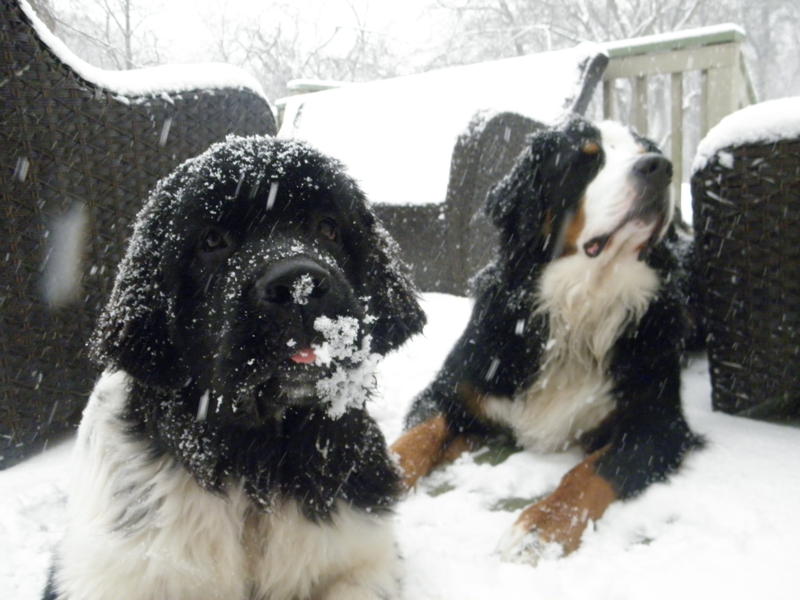
Polly, Lancelot's daughter.
This year there were six new breeds entered into Westminster: the Boykin Spaniel; the Bluetick Coonhound; the Cane Corso; the Icelandic Sheepdog; the Leonberger; and the Redbone Coonhound.
Many of the breeds are actually old breeds, but new to the dog show. The Cane Corso an Italian Mastiff had an impressive entry of 18 dogs and one more gorgeous than the next. This breed’s popularity has taken off in the past 10-15 years and especially in the North East. One of the handlers showing Vodoo, (see slide show), who is from Florida, said she was really surprised how many Corso’s were in the NY area. I remember going to Rare Breed dog shows about 10 years ago to see them, it was great to see them in the ring at Westminster this year.

Cane Corso's for the first time at Westminster
The Leonbergers also a new, old breed – just amazing in to see in person. Gentle giants in my opinion and just so beautiful to watch. They also had a good showing of 13 dogs in the ring, although they were so big, it seemed like more than that. I would not want to be a judge as they were all very impressive.
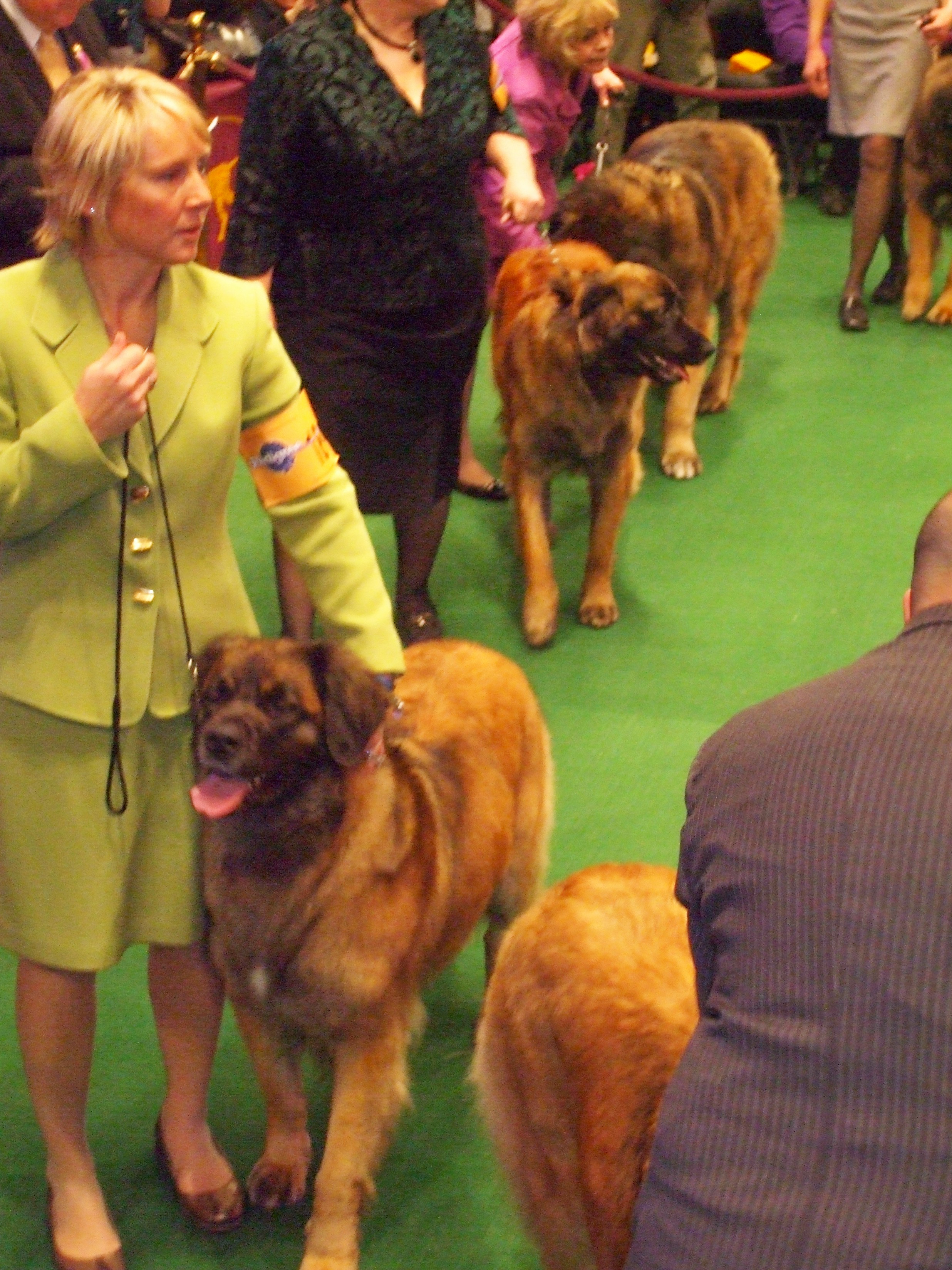
Leonberger's in the ring!
If you have never been to the Westminster Kennel Club Dog Show – this is a must do for anyone interested in dogs, mark your calendars for next year as this is the Best in Show of dog shows!


By Nancy E. Hassel, LIPetPlace.com with contribution from Dr. Keith Niesenbaum
Does your pet Floss?
Did you know that the month of February is National Pet Dental Month? Over the last few years every veterinarian that has spoken in the Town or Islip’s Free Dog Training & Education class has stressed the importance of brushing your dog’s teeth – daily. While most people giggle in the class about it, or look at the doctor in disbelief, “I have to do what?” Dental health in dogs and cats is very important. Smaller dogs often have worse dental disease due to the mere fact that their mouths are smaller, and teeth are closer together. But all dogs can suffer from periodontal disease as well as cats.
If you have a new puppy or kitten, the best time to start is while they are still young, getting them used to brushing their teeth. There are specially made pet tooth brushes and pet tooth paste, (do NOT ever use human tooth paste on a dog, it can be very dangerous to the dog), that you can purchase in any pet store. If you are not sure how to brush your dog’s teeth, consult your veterinarian on the proper tools and technique – this way you will not hurt your dog.
I asked local veterinarian Dr. Keith Niesenbaum his professional thoughts on pet dental health and this is what he had to say on the subject:
“Good oral health begins with regular examinations of the teeth and gums by your veterinarian. If a disease is found it should be treated immediately as early intervention can prevent serious conditions such as pain, tooth loss, kidney disease, heart disease, and systemic infections. Your veterinarian will probably recommend cleaning, both above and below the gum line and polishing, to remove micro etchings in the enamel, as well as treatments for any specific pathology that is found. Clients always ask me what they can do to prevent serious dental disease that will spare their pets more invasive procedures.
Prevention is always preferred to treatment. The obvious, and often off the cuff response to pet owners is to brush their pets’ teeth – just don’t use human tooth paste. Pets will swallow this and may vomit or even develop fluoride toxicity if they eat too much. Use a veterinary specific paste, they work well, are better tolerated, and won’t cause the problems of the human products. Besides, what pet can resist the allure of poultry flavored tooth paste? If you can’t brush at least 3 – 4 times a week, and most of us can’t seem to get that done, then the next best thing is dental chews. You want to get a chew that is appropriately sized for your pets and impregnated with enzymes that inhibit the build up of plaque, the precursor to tarter. The physical chewing activity is good, but the enzymatic activity is better. Non-enzymatic chews and bones are my next recommendation, especially if paired with some sort of anti bacterial rinse or water additive. Owners must be cautioned about chews though, if they are too hard, they can crack teeth, causing a more serious dental problem. If they can be chewed down to a size small enough to swallow whole, they can become lodged in the GI tract, necessitating surgery to remove them. Very aggressive chewers should be watched carefully and dogs especially should not be left alone with chews that they might get into trouble with.
Although none of these home programs will remove the tarter once it’s there. Flip your dog or cat’s lip and try to scrape that brown, mineral encrustation off with your fingers. There isn’t a brush or a bone in the world that will safely remove that concretion. Once it’s there, it needs to be professionally removed, and no amount is normal for a healthy mouth. Many veterinarians are offering some sort of incentive to promote dental health during the month of February. You should contact your veterinarian to see what programs they have in place. At Crawford Dog and Cat Hospital we are performing free oral health screening exams during Pet Dental Health Month and you can schedule an appointment on line 24/7 at http://petsmdbook.com/crawford/.”
Thanks to Dr. Niesenbaum for his sound dental advice for out pets and the next time you are flossing, or scheduling your own dental appointment, you may want to think about your dog and cat’s dental needs too!
Nancy Hassel: As a side note, I personally let my dog chew on marrow bones I get at a local health food store, specifically for dogs and made right here in the US. I happen to know my dog won’t try to eat that actual bone but rather chew on it, and do monitor him while he has it. Sometimes he chips away at it, but never swallows any piece-you have to know your dog, and know your breed. Be careful with any type of bone, as a huge mistake I bought one from a big box pet store one day and because of the process the manufacturer put the bone through (some sort of basting/cooking process) my dog cracked it in half within minutes of having it and it was a sharp as a razor. I immediately threw the bone in the garbage – since that scary instance I stick with the ones I have been buying for over 10 years.

by Nancy E. Hassel, LIPetPlace.com
Long Island happens to be home to thousands of feral cats – and this winter has been a tough one for many colonies across LI. Many of these cats and kittens are cared daily for by devoted volunteers of rescue groups that try to help deter the problem by trapping them, spay and neutering them and re-releasing them back into the colony their were trapped at. This is also know as Trap-Neuter-Return or TNR. There are exceptions that some younger cats or kittens that are not quite as feral and can be rehabilitated back into living in a home, are giving the chance to be put up for adoption.
Some may wonder where do all these cats come from? Why do we have such a problem with feral cats across our Island? Some contributing factors are people have the false information that cats can fend for themselves and dump cats they no longer want, or were not supposed to own if they were living in an apartment complex or college dormitory. Domesticated cats do not do well when abandoned, and many die from getting diseases that they were not exposed to before, get hit by cars or attacked by other animals. Other factors are people that have or live near a colony of feral cats and just feed them and never ask for help to have them spayed or neutered or know about rescue groups that offer low cost spay and neutering – and as nature would have it, kittens keep coming. I personally remember one house in Lindenhurst while taking my niece and nephew trick or treating a few years ago, there had to be at least 50 cats and kittens living around this house. The word was the owner of the house was feeding the cats continually but not doing anything about the overpopulation. This was in a neighborhood of close quarters and those cats were all over the neighborhood. It was quite sad as the cats were very feral.
Interestingly many of our college campuses have a feral cat problem as well. Stony Brook University actually has a program called SBU Cat Network in which faculty and students volunteer in to help the cats living on the University’s campus. In 2002, Associate Professor of Psychology, Dr. Nancy Franklin founded the program based on Stamford University’s model on how college campuses deal with feral cat colonies. The SBU, is solely dedicated to helping the cats on their campus, and is not an animal shelter. They do offer advice to people and other rescue groups about feral cats, but say that Stony Brook is not a dumping ground for cats, and they cannot take in unwanted cats.
Since the inception of SBU, they have rescued about 350 cats in which half were placed in homes and half were trapped, spay or neutered and released back to their colony. The campus currently has about 30 colonies on the grounds and each colony has an insulated shelter the cats can go into for warmth and to get away from inclement weather. The volunteer students and faculty feed the feral cats 365 days a year and also participate in fundraising for the group and TNR. And as with many other rescue groups raising funds is a challenge in this economy and our currently running in the Shelter Challenge.
Many of the cats that end up as part of a feral colony on the campus are a direct result of some students keep them illegally in dorms and then letting them go when the year is over. As part of the SBU Cat Project outreach, student volunteers do try to educate other students that dumping cats on campus is neither acceptable nor humane – and let them know they are not allowed to keep pets on campus. There are about 25 very active student volunteers in the program, 10 faculty volunteers and many other volunteers throughout the campus. Franklin said, “The University has been very gracious to us while we have been running this program and our volunteer students and faculty members have been wonderful.”
Another organization which serves the towns of Riverhead and Southold is SAVES (Spay, Alter, Vaccinate, Every Stray) a 501 c 3 all volunteer non for profit organization. Like SBU they have no shelter to house cats or kittens, but do have limited foster homes for feral cats that are suitable for homes (that become domesticated). SAVES main focus is TNR, care for the feral cat colonies in both towns – in which there are approximately 40 colonies with a total of about 500 cats. SAVES provides food, winterized shelters, medical attention (besides spaying and neutering) and have volunteers go to feed and check on the colonies daily.
The winterized shelters were originally provided by Shoreham Wading River High School, teacher Dave Driscoll, who and now is at Shoreham Wading River Middle School. Mr. Driscoll wants to work with SAVES to offer humane educational programs, and to help motivate the students to build new shelters. The winterized colonies are now built by a family of SAVES volunteers, but could use additional help in the building process. There are singular shelters and multiple cat shelters made with openings sized for cats to go in and out of, but not big enough for raccoons to get it, the shelters are also up off the ground to help protect the cats from bad weather.
SAVES President Al LaFrance said, “We get about 40 phone calls a week from people who need help with feral cats on their property or looking to re-home cats. We help people living in our territory with TNR, but do not have the resources to help with re-homing.”
SAVES has been going to Kent Animal Shelter for low cost spay and neuter for a while and in 2010 had about 250 spayed and neutered there and had approximately 600 cats spayed and neutered for the entire year about 96 of which were done for free by Helping Paw (a mobile unit) that came to Riverhead to help them. Others were spayed and neutered at the North Folk Animal Hospital and Mattituck Laurel Animal hospital – who they also go to for medical care for the cats.
Their main outlet for adoptions is at the Riverhead Petco in which they house cats and kittens available for adoption through SAVES. Volunteers go Petco 7-days a week 2-times a day to care for them and this past year they have adopted 177 cats. There is an application process that potential adopters must fill out and be approved, as SAVES is looking for permanent homes for their cats with proper care. SAVES is opposed to de-clawing and adopts cats out that will live indoors only.
The focus for them for 2011 is to have more feral cats spayed and neutered by continuing with working with Kent Animal Shelter and their other veterinarian partners, and set up free clinics with Helping Paw. They also plan to offer more humane educations programs and presentations for schools, and boy and girl-scout groups.
So what can you do to help? If you see a feral cat colony that no one is caring for, i.e. no shelter provided, no food or water provided and kittens continually being born, contact a local animal rescue group to let them know about it. (See below for list). If you have feral cats, and are just feeding them, you are very well adding to the problem – reach out to the public animal rescues for help with feral cats in your yard, facility or business.
Another way you can help is by making a monetary donation or donate much needed cat food to help the cats make it through the winter. If you are a cat lover, think about fostering a kitten or two to help them find new homes. Feral cats can very well become the best cat you may ever have had-they don’t all stay in the feral state into which they were born into. I speak from personal experience, taking in a feral kitten from the age of 3-months, who lived a very spoiled 16-years and was a very sweet, smart, funny and dog adoring cat. And yes, her name was “Kitty!”
All About Spay and Neuter – A full service TNR 501 c 3 non-profit all volunteer organization that does 100% TNR servicing Brooklyn, Queens, Nassau and Suffolk. They are not a shelter but can be called for help if you have a feral cat problem in your area. They do about 90 TNR’s a month and since their inception in 2004 have helped just over 5,100 feral cats of which about 850 have been adopted into loving homes.
Kent Animal Shelter – Has low cost spay and neuter.
SAVES Inc. – See above.

Kitty
Pet Therapy ...
by Pamela Fitzpatrick, of YourDogWalkers, shihtzu58@optonline.net
Pet Therapy
Have you resolved to do something for someone else in 2011? Maybe you and your dog can team up – if your dog has the right temperament, he or she may be able to be a therapy dog! Therapy dogs are specially trained to provide comfort and affection to anyone in need: people in hospitals, retirement and nursing homes, special needs schools and more can all benefit.
Dogs of any size or breed can be a therapy dog. The single most important characteristic of a therapy dog is its temperament. A therapy dog must be patient, friendly, calm, confident, gentle, and comfortable in all situations. Therapy dogs are “people” dogs; happiest when they are in contact with people (familiar or unfamiliar), petted and handled, albeit sometimes clumsily.
Therapy dogs are trained to allow unfamiliar people to make physical contact with them, and most recipients enjoy the contact! Children in particular enjoy hugging animals; adults usually enjoy simply petting the dog. The dog might need to be lifted onto, or climb onto, an individual’s lap or bed when invited and should be able to sit or lie comfortably there upon command. Some therapy dogs contribute to the visiting experience by performing small tricks for their audience or by playing carefully structured games.
My friends Chris and Cynthia Buckley live in Colorado and have a gorgeous Goldendoodle named Custer who recently qualified as a therapy dog. Custer went through a rigorous training program through Pet Partners, which is sponsored by the national Delta Society and now regularly visits residents of a local senior living center. In addition to basic obedience, Custer learned not to react to loud noises, pulls on his tail or ears, or sudden movement. Custer’s calm temperament made him an ideal candidate for the program. Chris, Cynthia, and Custer trained for several months, and Custer passed the test last spring, earning his official Pet Partner’s Delta Registration status. As you can imagine, Cynthia and Chris are very proud of their dog, and happy that he brings joy into the lives of others.
If you think your dog might be a good candidate for a therapy dog or just want to learn more, Long Island Dog Directory (LIdogdirectory.com) is a good place to start. Click on the therapy tab for more info.

Categories
Archives
Blogroll
Meta